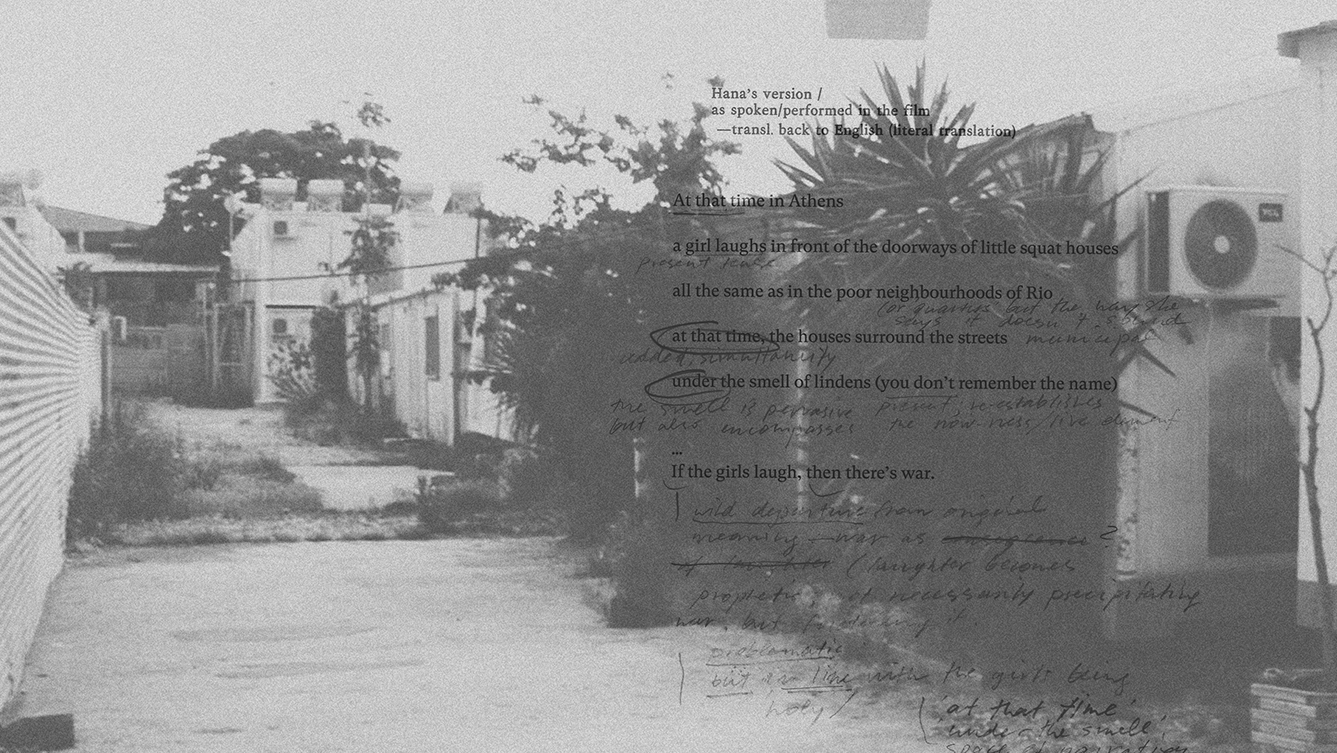
This experiment began with the translation of a poem for a film set in the Eleonas refugee camp in Athens. The poem, Pier Paolo Pasolini’s Athens, is a portrait of an enigmatic place on a summer evening, in times of uncertainty. Originally, the purpose of the translation was simply to produce a Farsi version that the actor could recite in the camp, but curiosity about translation then led to a series of collaborations. How does translation complicate the themes of the film, such as migration, refugeeism, belonging and not belonging? What might translations into other languages and across mediums reveal about Pasolini’s poem, my film, and about cinema, poetry, and language more broadly? I invited artists and historians to translate excerpts from the same poem into their native languages – Yoruba, Arabic, Farsi, Basque, Maltese, Tagalog, Polish, Greek – and to discuss the process. The poem has not only travelled between languages, but also across mediums – written text, audio recording, performance, and film. This exposition is my record of these dialogues and processes – a personal, albeit polyphonic notebook on translation.
passages in translation
Ektoras Arkomanis is an artist and writer. He uses film for its capacity to preserve and explore, but he is especially interested in what the medium omits, its inadequacy for describing things that are no longer there, and the narratives that are invented to fill these gaps. He is currently working on a series of films about the district of Eleonas in Athens; the latest one, work / memories of work, was released in 2024.
Ektoras has published essays and articles on film, architecture, and art, and has edited a volume titled Migrations in New Cinema (Cours de Poétique, 2020). He recently co-created a collaborative installation titled Protea/Extraction (commissioned by the Anti-Apartheid Centre of Memory and Learning in London), which explored colonial histories of exploitation and commodification of natural resources in South Africa.
Ektoras teaches history to architecture students at London Metropolitan University.
Visit the exposition in the database Research Catalogue.